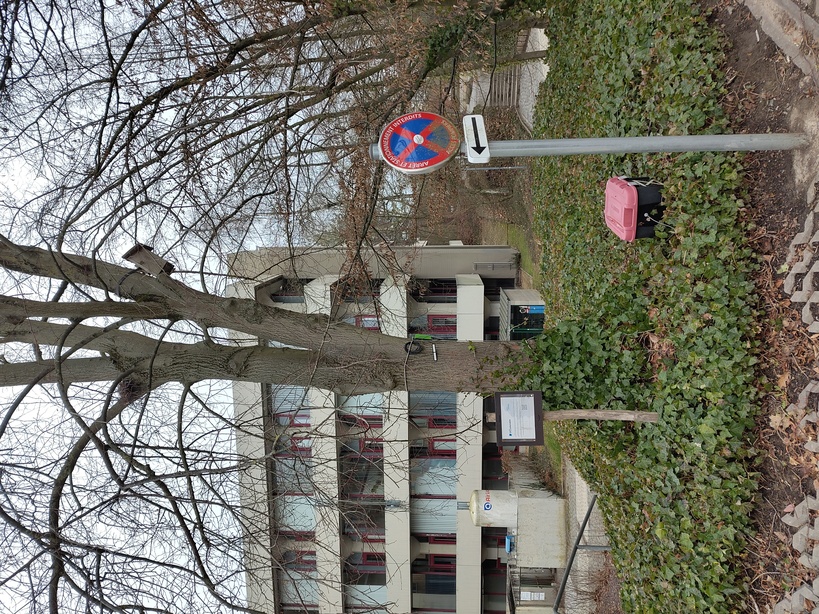
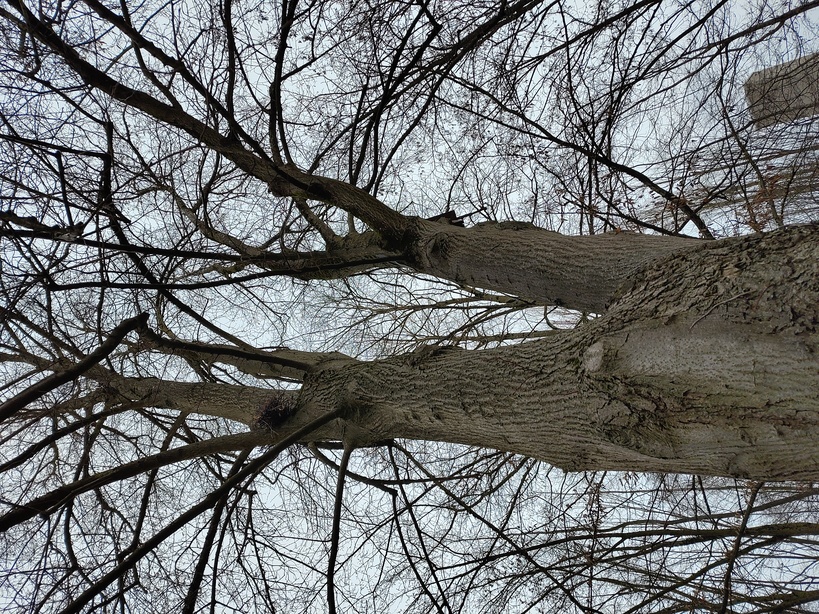
I am a Lime Tree. I live on the parking lot of the Faculty of Bioengineering in Louvain-la-Neuve (BE). From April 2026 to January 2027 I’ll participate in the artistic research project and installation ‘ROOTS’ (Revealing Opaque Organic and Technological Systems) thanks to the support of UCLouvain Culture.
2026, Lime Tree, parking lot, Louvain-la-Neuve
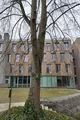
ROOTS proposes to create a locally trained language model (LLM) from scratch, fed with scientific and literary data related to trees. Connected in real time to the sensors installed on my trunk (sap flow, diameter variation), cross-referencing these data with meteorological data, this LLM will become the interpreter of a living plant organism.
Three key moments in the LLM training process will be the subject of original algoliterary publications -that is, literary works generated by an algorithm: word embeddings, the self-attention mechanism, and the automatic generation of text.
Activities
The entire process - data collection, training, documentation of choices, visualization of energy costs, limitations, and potential - will be documented on a wiki that will be organized as a training module for UCLouvain in order to demystify LLMs and question humankind’s relationship with technology and living organisms. In the autumn of 2027, the algoliterary publications will be presented digitally in an exhibition at the Christine de Pizan Learning Centre (UCLouvain) and via a QR code installed near my trunk. During the same period, the Brussels-based arts centre nadine will facilitate risograph prints of the algoliterary publications and hold a reading event. The Mariemont Museum of Literature will exhibit the algoliterary publications series and host an event.
Algoliterary creation
ROOTS recombines two types of activity already present in Anaïs Berck’s work: the aesthetic interpretation of data from tree sensors, on the one hand, and the creation of algorithmic literature, on the other.
Indeed, in recent years, Anaïs Berck has created installations in collaboration with fellow trees in Arnhem’s parks - Arnhemse Bomen Vertellen (Arnhem Trees Tell) - and in three nature reserves in Flanders - Tree Times. These installations made visible aspects of us, trees, that are invisible to the human eye. By collaborating with the Faculty of Bioengineering at UCLouvain, Anaïs Berck will continue to develop this thematic line.
Within the context of the FRART project - An Algoliterary Publishing House: Making Kin with Trees - Anaïs Berck created several algorithmic literature works, where the author is a particular algorithm that develops the narrative in a Dadaist manner. These online works are generated in real time and can be printed as PDFs.
Algorithms as authors
For the ROOTS algorithmic literature projects, Anaïs Berck will collaborate with three key algorithmic collectives involved in training a language model:
- Word embeddings: For a model to process language, words must first be translated into numbers that can be manipulated by a machine. Each word is thus represented as a point in a multidimensional space, where distances and orientations reflect semantic relationships.
- The self-attention mechanism: The central mechanism of ‘transformer’ architectures, like ChatGPT, which demonstrates how the model weights the words in a sentence differently to produce a contextual representation of language.
- Automatic text generation: This is the best-known aspect of language models; the ROOTS website will allow for the generation of text based on the tree’s data in real time.
For each algorithmic collective, Anaïs Berck will explore metaphors related to our functioning - for example, when the temperature rises, the temperature functions that contribute to the final text generation will also increase, resulting in a generated text that is more creative.
Opening black boxes
ROOTS thus focuses on a fundamental tension: we, trees, and language models share the paradoxical status of black boxes. We, on which you, humans, have always depended, act silently, without you truly understanding the internal dynamics that regulate our activities. At the other extreme, LLMs are ultra-contemporary entities, ubiquitous in your daily interactions. You actively interact with them while largely remaining ignorant of their internal mechanisms and material dependence.
The project proposes to open up these two black boxes simultaneously. This juxtaposition produces a striking contrast, as we, trees, purify the air and make life possible, while LLMs consume energy and indirectly contribute to climate change.