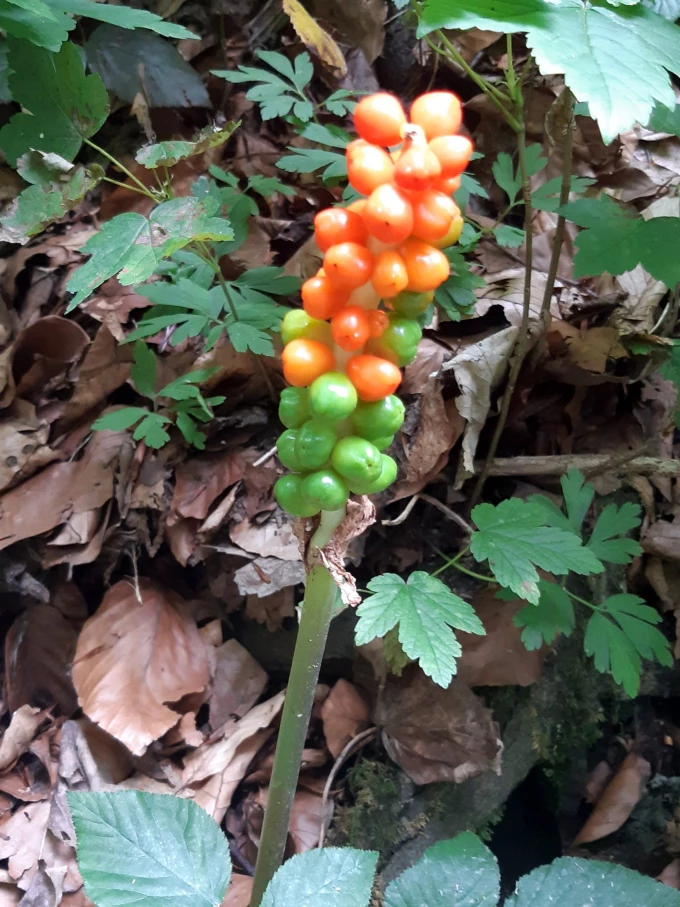
The first berries of the Cuckoo-pint have arrived! When you see these sunny stems, you know that you are walking on a nutrient-rich soil in an oak or beech forest. Cuckoo-pints are rare in most places, but not in the Forêt de Soignes.
The creation of these berries is a fairy tale worth telling. In Spring, this plant forms a spadix that folds half open. The flower is built up like a two-storey hotel separated from each other and from the outside world by wreaths of hairs. The top floor is occupied by the male flowers, the lower by the female.
Every evening astylsalic acid is burnt in the hotel, which gives off a scent that resembles an corpse scent. Flies and mosquitoes that normally feed on corpses are attracted to it. With their facet eyes they can’t see the spadix and bump into it. The blow stuns them for a moment and they fall down the butt through the hairs. There they are being hosted by the male flowers for three days. Well, hosted… They are locked up and get nothing to eat. Their presence activates the male flowers, which bloom after two days. They lose pollen falling on the flies. Moments later, the top row of hairs wilt and the flies can escape.
Starving, they go in search of food. Preferably they are attracted again to the scent of another, just in bloom, cuckoo-pint and fall down to reach the ground floor this time. There they fertilize the female flowers with the pollen they brought with them. Sometimes I wonder if the insects are traumatized by this involuntary confinement.
The cuckoo-pint can be found in Spring near the delicious edible wild garlic, something to look forward to. As for the cuckoo-pint, the tuber is edible, if you cook it well first. It is best to harvest the tuber at the end of Autumn. As Robin Wall Kimmerer states in her book ‘Gathering moss’, every plant comes when and where it is needed. And yes, the starch of the cooked tuber would be good for coughs and sore throats, the typical winter diseases.
Cuckoo-pint