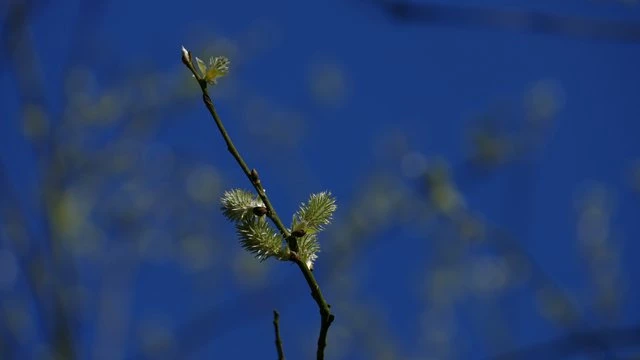
The goat willow brings the first colour to the spring sky. Here the catkins are still green. Soon they will turn yellow and you can hear their presence from afar by the buzzing of bees and other insects. Each catkin has a honey gland, which gives them a delightful perfume.
Also in the ecology of the forest willows are scouts, pioneer trees. Their seeds have fine hairs, which makes them easy to fly with the wind. They nest easily in inhospitable or polluted places. They can be found all over the world in different sizes and species - with the exception of Australia.
The willows inspired the most famous painkiller, the Aspirin. The salicin that forms its basis is released in tea made from dried willow bark. But willows are even more famous. Their branches, twigs and inner bark are so flexible that baskets and carpets are woven from them, and even rope and fishing nets.
They often grow near water. In Celtic terms, sal-lix literally means near-water. Salix caprea or goat willow is the species that goats would love. It probably owes its name to the earliest image found in Hieronymus Bock’s herbal book from 1546. It showed a goat nibbling lustily on the young foliage of a ‘goat willow’.
Goat willow