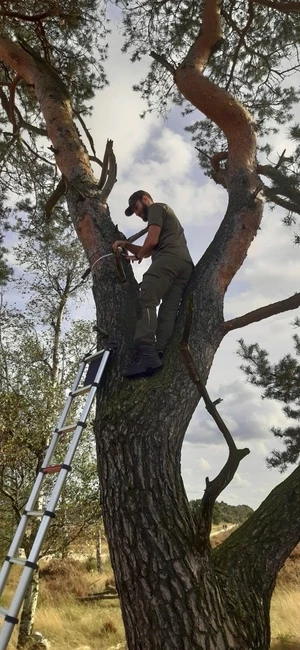
When does my tree’s sap start flowing, when do I get active in the morning, when does my trunk grow most? For a year, the artists of the Anaïs Berck collective collaborated with me and two other Scots Pines in three nature reserves in Flanders, with the intention of designing tree clocks.
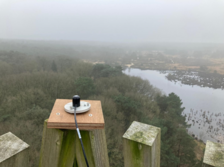
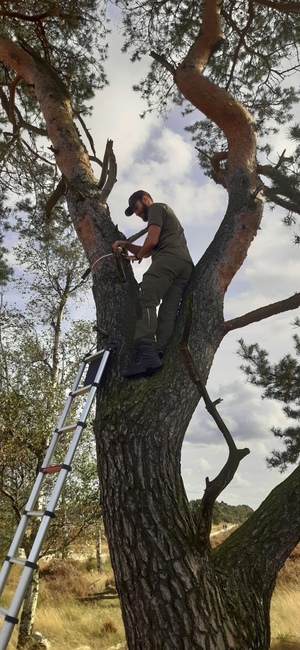
They recorded my movements using sensors that measure the expansion and contraction of my trunk, my CO2 absorption, the air temperature and humidity, and the sunlight.
Although we live in similar habitats — the sandy and heathland soil of the Kalmthoutse Heide, Bosland National Park, and De Liereman — our internal clocks show significant differences. Should that be surprising?
The project was inspired by the idea of criptime, a notion of time invoked by people for whom normative time often doesn’t meet their needs. A workday from 9 till 5, a route from A to B which should take ten minutes to walk according to the algorithm’s prediction; but also life events that would normally occur, such as living autonomously, getting married, having children.
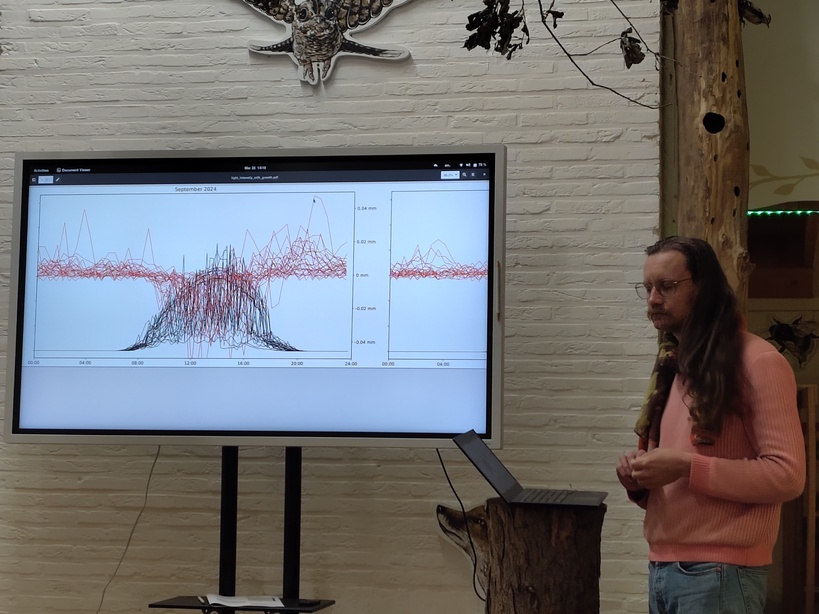
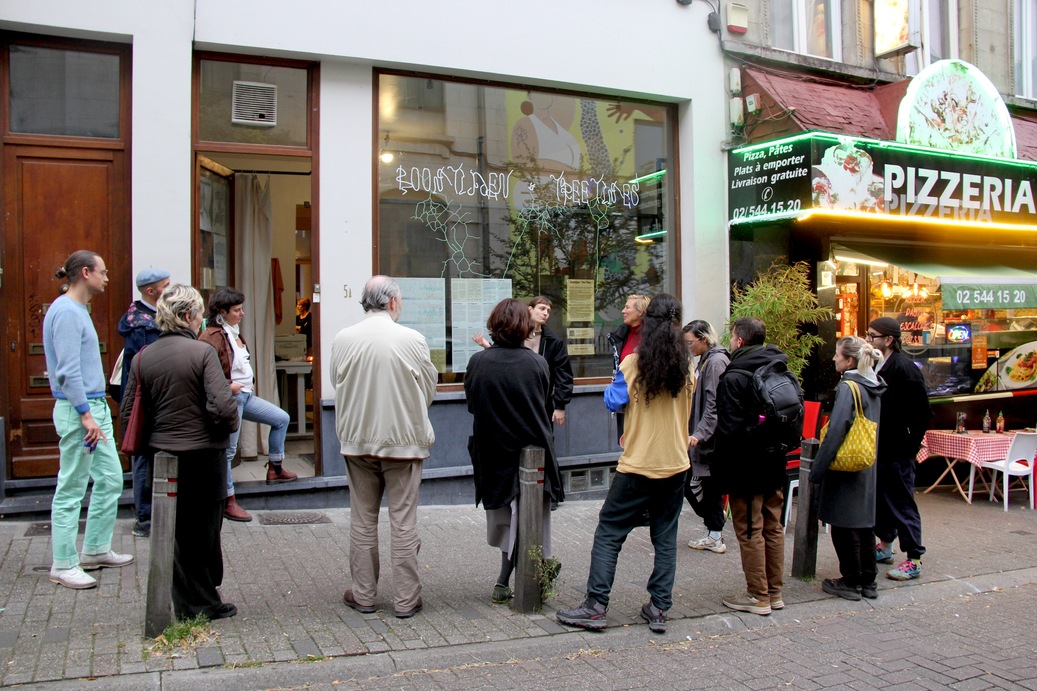
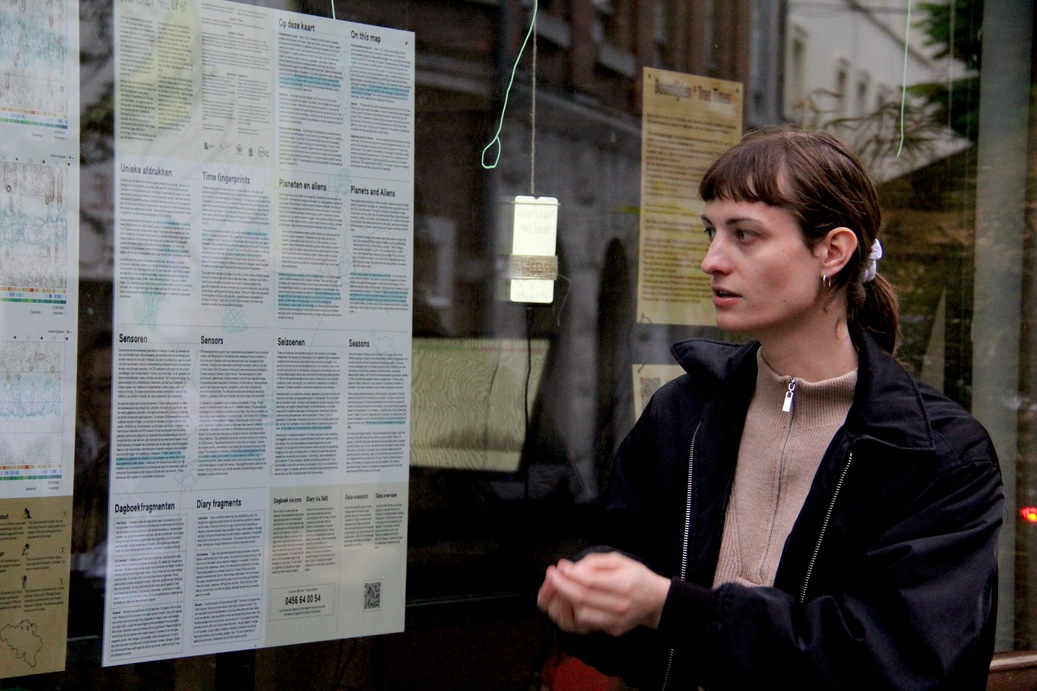
Therefore, Anaïs Berck created an artistic map displaying all the data points, along with the phases of the moon and the seasons. A web app also displayd the detailed data for those interested in delving deeper into the observations.
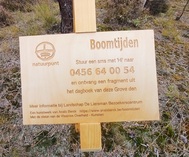
And finally, a tree clerck took the time to communicate with us and compiled a diary. It includes unusual days, whether due to our tree activity, weather conditions, or the start of a new season. You can request a fragment of the diary via SMS – experimental SMS literature!
During the moon cycle from 7 October 2025 till 5 November 2025 we showed the results of this research in Constant (Brussels), visitor centre De Liereman (Oud-Turnhout), Boslab (Hechtel-Eksel) and visitor centre De Vroente (Kalmthout).
Collaborators
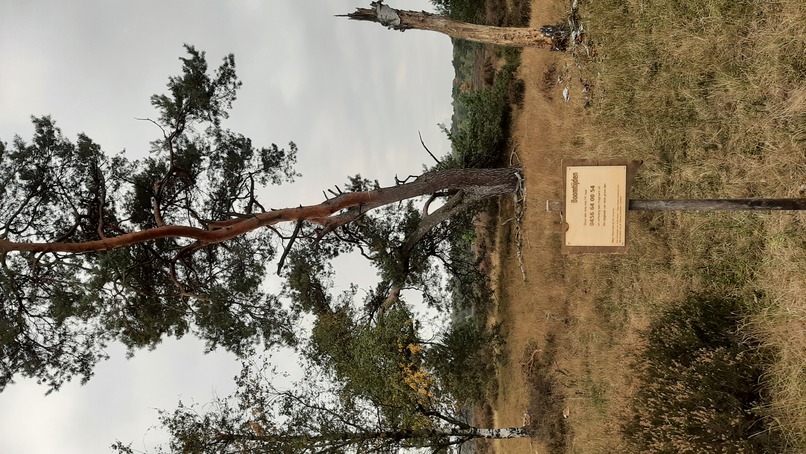
As one of the three Scots Pines, I am honored to introduce my colleagues. In Landschap De Liereman, and more specifically in Korhaan, lives a Scots Pine that, like me, is a wind-blown pine. We have grown from seeds that arrived with the wind. We live in an open environment, surrounded by a few other trees at a distance. For this research project we were installed with a band dendrometer, a CO2 and air sensor and a soil sensor.
In National Park Bosland, near the Forest Museum, another Scots Pine lives in a forest stand. Its crown is much smaller and catches less sun. On the other hand, it is much more protected against wind and storms. This Scots Pine was installed with sensors from UGent, under the supervision of Dr. ir. Kathy Steppe and at the initiative of Boslab, the scientific lab of National Park Bosland in Hechtel-Eksel. We are allowed to work with their data, attend their consultation moments and also showed our artistic experiments to them.
My human colleagues were programmer-designers Gijs de Heij and Doriane Timmermans from the experimental design collective Open Source Publishing in Brussels; tree clerk and artist An Mertens; Aelyn Van Diest, a bio-engineer by training with 25 years of experience in nature management in the specific biotope of sandy soils, forests, heathland and fens. Aelyn also has a spiritual-energetic approach to nature. And finally, Anne-Laure Buisson was also participating, a data scientist with a great love for trees.
A big thank you to forester Eddy Ulenaers & scientist Marjel van den Boer (Boslab), tree worker Sven Boets, writer and artist Achilles Cools, Kristof Sprengers, Carola Van Hove, Kris Van der Steen, Paulien Maes, Marian Mertens, Rose Govaerts (team De Liereman), Peter Noben, Sofie Regniers, Jef De Winter and his tree workers, Marc Vogels (team Kalmthoutse Heide)
Partners
Vlaamse Overheid, Kunsten – Constant vzw – Bezoekerscentrum De Vroente – Landschap De Liereman – Boslab